SCHOOL LEAK DETECTION
Heating and underfloor heating leak detection in schools
Trace pressure loss and leaks in heating circuits and buried floor pipes.
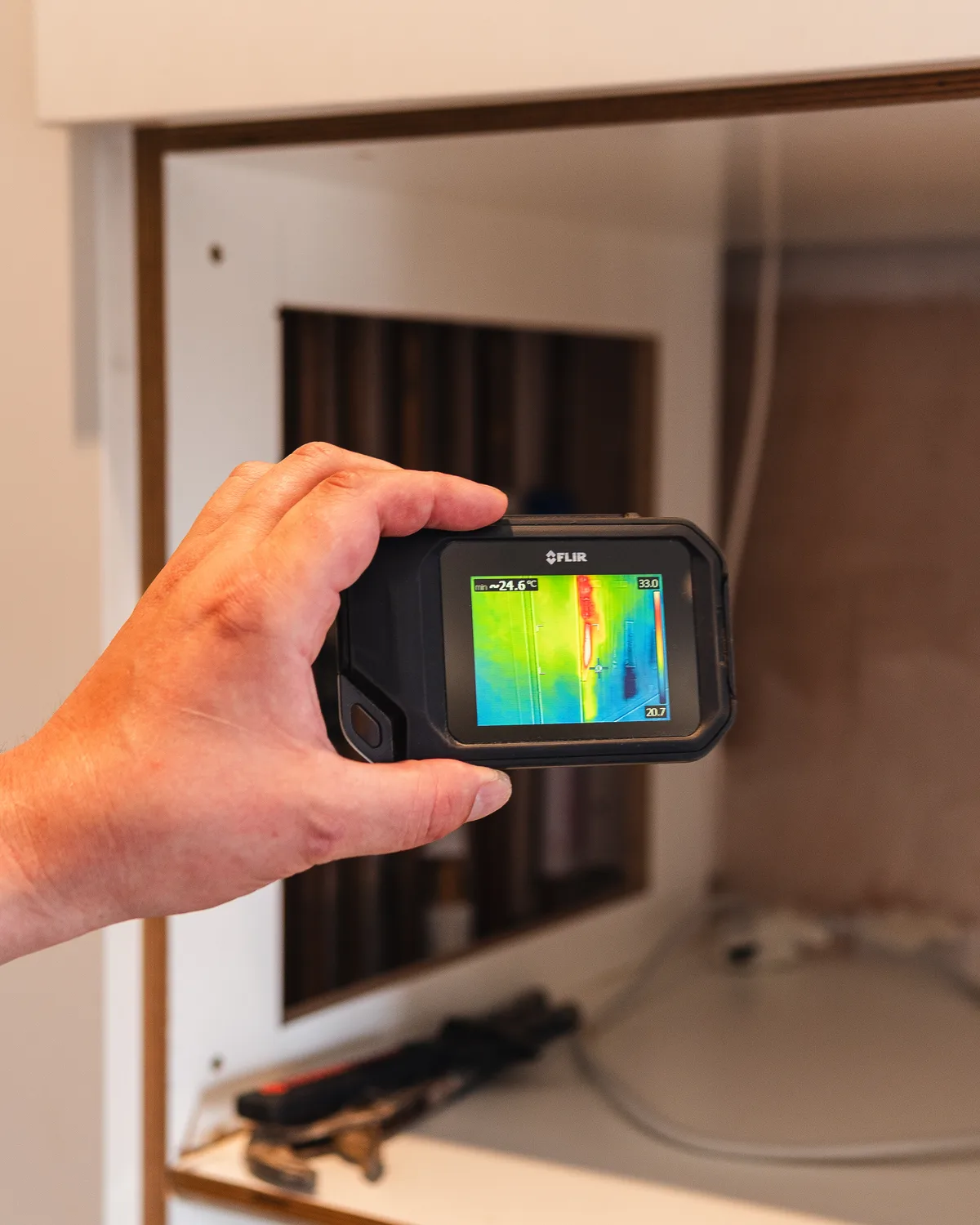
A sealed school heating system that needs topping up is leaking, and thermal imaging with tracer gas locates the point without lifting the screed to look for it.
WHAT TO LOOK FOR
Leak symptoms and common faults
- Screed-buried pipework corroded or perforated in a hall or extension
- A warm patch on the floor and a boiler needing weekly top-up
- Underfloor heating circuit punctured by a later fixing
- One loop cold or one zone that never reaches temperature
- Buried steel heating main between blocks failing at a joint
- Large continuous make-up demand with no internal evidence
- Corroded pipework in a duct or riser
- Staining or damp at low level in a corridor near the riser
- Failed pressurisation unit or expansion vessel mimicking a leak
- Pressure loss that stops when the unit is isolated
Where heating pipework runs in a school building
Older schools run heating in ducts under corridors, which is inconvenient but at least accessible. Post-war and later buildings frequently ran it in the screed, which is cheap to install and unforgiving to repair. Modern extensions and refurbishments use underfloor heating for the same reason schools like it: no radiators for children to climb on and no hot surfaces.
The consequence is that the most common school heating leak sits under a floor that cannot be lifted during term, in a room the school needs.
Why a boiler that keeps losing pressure is a leak
A sealed heating system is a closed loop. Water that goes in should stay in. If the site manager is topping it up weekly, the water is going somewhere, and on a school site it is going into a screed, into a duct, or into the ground.
There are two innocent explanations worth ruling out first: a failed expansion vessel, which makes pressure swing rather than fall, and a leaking pressure relief valve discharging to a tundish. Both are quick to check and both are far cheaper than a floor.
How a heating leak is located without lifting the floor
- Confirm the loss by pressure testing the circuit and measuring the rate, so the size is known before anyone looks
- Isolate zone by zone at the manifold to identify which loop or branch is losing
- Run the system up to temperature and survey the floor thermally, which shows the warm plume around a leak on a buried flow pipe
- Introduce tracer gas into the isolated, drained section and survey the floor surface where the thermal image is ambiguous
- Mark the point, then break out a single small area rather than chasing the pipe
Thermal imaging alone is often enough on underfloor heating because the pipe is shallow and the leak is warm. It is much less reliable on a deep screed-buried main in an old building, which is where tracer gas does the work.
What the survey needs from the school
The heating needs to be running, or capable of being run, and the plant room needs to be accessible. The rooms being surveyed need to be clear of furniture on the floor area being scanned, which is usually the only real disruption.
A thermal survey works best when the floor has had time to reach a steady state, so an early start on a cold morning gives a clearer image than an afternoon in June.
Repair options once the point is known
Once the position is fixed there are usually three options: break out and repair the pipe, bypass the failed section with a new surface-run or overhead route, or abandon the loop and replace the zone. Which is right depends on the age of the system and whether this is the first failure or the third.
Reinstating a floor in a teaching space means matching a finish and letting it cure, so the programme is usually longer than the repair. That is a holiday job in most schools.
Arrange a school leak detection survey
School leak survey questions
Our caretaker tops the system up every Monday. Is that normal?
No. A sealed system should hold its pressure. Weekly top-up means a continuous loss, and it is also damaging the system, because each top-up introduces fresh oxygenated water that accelerates internal corrosion.
Can you find a leak under a screed floor without breaking it up?
Yes, that is the point of the survey. Thermal imaging shows the warm plume above a leaking flow pipe, and tracer gas locates it where the thermal signature is unclear. The floor is opened once, at the marked point, rather than chased along the run.
The leak is under a classroom. Can it wait until the holidays?
Usually, provided the loss is small, the make-up water is being treated and nothing is being damaged. It cannot wait if water is reaching an electrical installation, if the floor is lifting, or if the loss is large enough to leave the building unheated.
Sources for this page
Last reviewed . How this site sources and dates its figures.