SCHOOL LEAK DETECTION
Swimming pool leak detection for schools
Investigate falling water levels, pool fittings and circulation pipework.
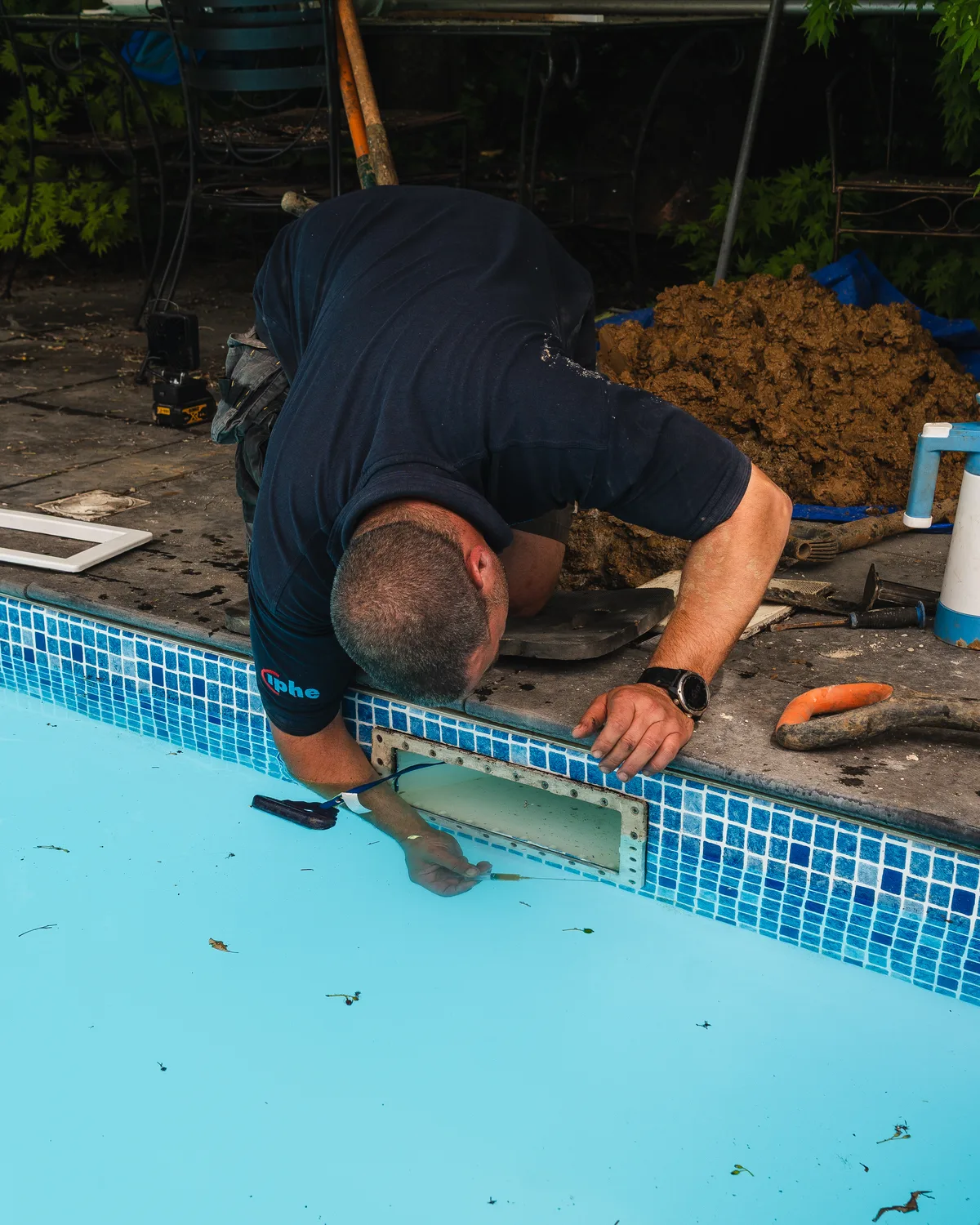
A school pool losing water is tested against evaporation first, then split into shell and pipework, so only the failing part is investigated rather than the whole installation.
WHAT TO LOOK FOR
Leak symptoms and common faults
- Shell or liner failure at a joint, expansion strip or fitting
- A loss that continues at the same rate with the circulation off
- Circulation pipework failure between the pool and the plant room
- A loss that stops or slows when the circulation is isolated
- Balance tank overflowing or its level control failing
- Continuous top-up with no drop in pool level
- Backwash valve passing to drain
- Water audibly running to drain when the plant is idle
- Failed pipe penetration through the shell at inlets, outlets or lights
- Localised ground wetness or a damp patch in the surround
Separating evaporation from a genuine leak
Every heated pool loses water to evaporation, and a warm indoor pool in a hall without humidity control loses a great deal. Before anyone investigates a leak, the loss has to be measured against what evaporation alone would produce.
- Stand a bucket of pool water on the steps so it sits at the same temperature and in the same air
- Mark the level in the bucket and the level in the pool at the same moment
- Leave both for 24 hours with the pool not in use and no top-up
- Compare the two drops: evaporation affects both equally, so any extra fall in the pool is a loss
Record the metered top-up over the same period. A number in cubic metres is what turns "the pool seems low" into something a contractor can quote against and a funder can read.
Shell or pipework: the test that decides everything
The next question halves the problem. Isolate the circulation and repeat the measurement. If the pool keeps losing at the same rate with the circulation shut down, the loss is through the structure. If it slows or stops, the loss is in the pipework.
That single test is worth doing before commissioning any survey, because it determines whether you need a structural investigation of the shell or a pressure test of the circuit, and those are different jobs.
How the position is found without emptying the pool
For pipework, the section is isolated, pressure tested to establish the rate, then charged with tracer gas and surveyed at the surface above the run. This finds a buried circulation leak under a pool surround without lifting the surround.
For the shell, dye testing at suspected penetrations, expansion joints and fittings identifies where water is leaving while the pool stays full. Emptying a pool is a last resort: it takes days to refill and reheat, and an empty tiled pool in a hot hall can crack.
What the loss is actually costing
A pool leak costs three times over: the water, the energy to heat the replacement, and the chemicals to treat it. That makes the annualised cost of a pool leak far higher per cubic metre than a cold water leak, which is usually what justifies the investigation.
For a hydrotherapy pool in a special school there is a fourth cost that does not appear on any bill: the therapy programme stops while the pool is out.
Arrange a school leak detection survey
School leak survey questions
Our pool drops 10mm a day. Is that a leak?
It depends entirely on the pool temperature, the hall temperature and the humidity control. A warm indoor pool in a poorly ventilated hall can lose that much to evaporation alone. Do the bucket test before assuming, because it costs nothing and answers the question.
Can you find the leak while the pool is in use?
The measurement work needs the pool quiet, ideally overnight or across a weekend, because splashing and swimmers make level readings meaningless. The pipework survey can generally be done without closing the pool.
Our balance tank is always calling for water but the pool level is fine. What does that mean?
That pattern usually points to the balance tank or its level control rather than the pool. A tank overflowing to drain, or a level probe that has drifted, will call for make-up continuously while the pool itself is perfectly sound.
Sources for this page
Last reviewed . How this site sources and dates its figures.